



| TOPIC: Basing... again |
  Standard User Posts: 58  Basing... again Basing... againHuubStegeman 6th Jun 2018 09:43:05 Hi there, Now my Romano British project is half way through, I'm already thinking of the next project: Macedonians + Persians + Indians. Meanwhile I've looked at some different rulesets, and I've played the Kallistra hex-systeem (with borrowed 15mm guys, way to big for me! :-) ). I'd like to base my new armies in the most flexible way possible. The 60x30mm bases my Romans and Celts are on look great, but people keep suggesting I use 40x20 for greater flexibility with other systems. What are your experiences? I want to be able to try many different rulesets. Cheers |
 Standard User Posts: 505 Basing... againLEmpereur 6th Jun 2018 01:34:34 Hello HuubStegeman, In France, 40x20mm are use for DBX games and there sucessors... and We never see any 6mm on that kind of games. 10mm or 15mm but no 6mm. We are new on this scale and we have studied different rules before positioning ourselves on 60x60mm or 60x30mm. L'Empereur Béte et Méchant vous invite à visitez : Le Blog : https://lempereurzoom13.blogspot.fr/ & Le Projet 2020 : https://2020batailledeloigny.blogspot.fr/... Cons se le disent!!! At the top left of each blog, feel free to select your language to translate Her Majesty's Prose! |
| Standard User Posts: 1244 Basing... againdourpuritan 6th Jun 2018 04:40:07 40x20, or deeper for some units, such as pike, will work very well with To the Strongest, which has units of 120mm frontage. This is also the frontage used by Impetus. Those are two sets for the period where the unit is the base (or multiples of 40mm to achieve the base frontage). Some people prefer to use those rulesets with 80mm frontage units when using smaller figures, which has the added advantage of smaller battlefields and less costly armies (and painting time). A little goes a long way |
Standard User Posts: 406 Basing... againGlenn Pearce 6th Jun 2018 04:51:59 Hello HuubStegeman! Common usage of 40x20 predates 60x30. Once Baccus established 60x30 as the most practical use for 6mm it became somewhat of a standard for 6mm. You can use 60x30 for almost any rule set. Some as is and others generally with just a couple of house rules. I'm not aware of any popular rule set that prohibits the use of 60x30 bases. It's always better to mount your figures on bases to match the scale, not the rule set. Also having a common basing system for your figures allows you to have a common storage system as well. You can even buy and sell painted 60x30 bases on line as they have become so common. Anyone suggesting you switch from 60x30 to 40x20 probably has very little if any 6mm expereince. Best regards, Glenn |
Standard User Posts: 95 Basing... againI am a spambot 7th Jun 2018 06:09:38 My 6mm ancient armies are all on 40mm wide bases using a simplified version of the DBA basing scheme. (I have a dislike of 40mm by 15mm bases for 6mm figures and have been phasing them out in favour of 40mm by 20mm bases.) If you want armies with chariots (such as New Kingdom Egyptians or Hittites) then you will need to have some 30mm or 40mm deep bases for these. If you want 2 ranks of cavalry on a base then you would want 30mm deep or more bases. My ECW armies are also on 40mm deep bases. I use 60mm by 30mm bases for my Napoleonics and AWI armies. (For Napoleonics I use deeper bases for artillery.) This works for me for the horse and musket periods because I use up to 2 casualty markers per base with the rules that I play, and the larger bases have more room for them. I also like the colour parties to be in the centre of the infantry units, and not comprise a quarter of a unit. (Ancients and ECW units don't tend to get flags or standards unless they are where the general is.) Disadvantages include extra expense for figures, slight inconvenience in storing, transporting of figures, and increased playing area. With regards to rules, most rules can be played with differing base sizes, basing schemes and figures from what the rules authors expect. For Napoleonics and AWI, I use the DBN rules from KISS (which were originally an adaption of DBA but have since diverged significantly). The DBN rules say that with figures smaller than 15mm, you should use the base sizes for 15mm figures (40mm wide bases) and use twice as many figures. I use a greatly simplied version of their 60mm wide basing scheme for 25mm figures, the movement and firing distances for 25mm figures, and put several times (typically 6 times) the expected number of figures on a base. |
| Standard User Posts: 1244 Basing... againdourpuritan 7th Jun 2018 12:26:03 I really dislike sweeping statements made with regard to nothing but gut feeling which nevertheless give the appearance of "this is how it is done and anything else is wrong." My incredible lack of 6mm experience dates from the early 1980s and I use a variety of basing methods with 6mm figures: 60x30 for ACW Altar of Freedom, 80xappropriate for To the Strongest, 30x20 for Bloody Big Battles (C19th), 25x25 for WWI. In essence base for the way that you want to play. I bought my house to be my home, not for future resale, and I do the same with my wargames figures. A little goes a long way |
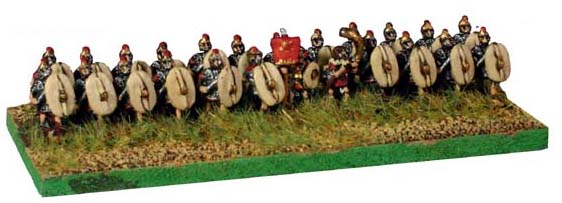
| Standard User Posts: 58 Basing... againHuubStegeman 7th Jun 2018 01:47:38 Thanks all! From the comments so far I get the impression that is in the end very much a matter of aesthetics, and that most (maybe not all) problems have to do with the (perceived lack of) 'splittability' of units, which I guess could be compensated for with some type of markers (casualty, maybe even column vs line, if at all needed). Slighly off-topic, but inspired by this idea nevertheless: has anyone ever considered making a 'testudo marker', say in the form of a bit of thin carboard with shields printed on them, to be placed as a cap on the aesthetically pleasing 60x30 stand (or any other format, for that matter)? H |
| Standard User Posts: 1244 Basing... againdourpuritan 7th Jun 2018 09:41:32 Not thought of that one, although I notice that Peter has actually turned the base 90 degrees to mount shot sleeves for an ECW unit, which looks very impressive. I have created painted casualty markers for a couple of ACW 3mm armies I have as 3D casualty markers in that range are unavailable. A little goes a long way |
| Standard User Posts: 58 Basing... againHuubStegeman 3rd Jul 2018 02:21:15 Coming back to this on a related note: Would you put 1 Celtic chariot on a 30x30 base, or 2 on a 60x30 base, if you're aiming for the greatest rule flexibility? |
| Standard User Posts: 1244 Basing... againdourpuritan 3rd Jul 2018 02:40:12 Not got any 6mm chariots so unable to visualise that, but I would probably try and squeeze more on. A little goes a long way |
> Forums
Reply
12
> Rules > Other Rules > Basing... again1
NEWS
This week at Baccus17th Oct 2026
Twas the day before Partizan...
10th Oct 2026
EU U-Turn and a Mission
25th Sep 2026
JOS26 - Gone, but not forgotten...
11th Jul 2026
It's That Most Wonderful Time of the Year!
26th Jun 2026
LATEST FORUM POSTS
A week at Baccus by peter17th Oct 2026
Batavian Republic 1799 by I am a spambot
15th Oct 2026
Batavian Republic 1799 by jwsleser
14th Oct 2026
Batavian Republic 1799 by I am a spambot
14th Oct 2026
Batavian Republic 1799 by rsjahn
14th Oct 2026
UPCOMING SHOWS
Fiasco (Royal Armouries, Leeds)25th Oct 2026
Warfare (Farnborough Exhibition Centre)
14th Nov 2026-15th Nov 2026
Battleground (Stockton on Tees)
29th Nov 2026
LATEST RELEASES
 arr6
arr6 miss
miss WBT49
WBT49Churchill NA75
 WGP88
WGP88JgPzVI Ferdinand
 WGP53V
PzVG Panther veterans